I’m happy to announce that I’ve signed with super agent Lisa Bankoff to represent my new novel, JACKSON. This has been a long time in coming so, yeah, I’m pleased. I’ll post any updates here. Meantime, here’s the pitch, in case you’re curious:
JACKSON takes its title from the small town of Jackson, Louisiana. The town’s best known as the site of the state’s first public mental hospital, and it was there, as the son of a psychiatrist, that I grew up, living and roaming on the grounds of the old asylum, hearing the screams of the patients at night. That unusual childhood experience provided the inspiration for this story.
JACKSON is a modern-day Frankenstein tale set against the backdrop of shocking, real-life brain implant experiments conducted on patients in Louisiana public mental hospitals in the 1960s. Told from the shifting points of view of Dr. Eugene Grant, a newly trained psychiatrist, and his young wife, Callie, the novel follows the couple and their son as they settle into a home on the grounds of Louisiana State Hospital, an immense, antiquated asylum in a remote corner of the state. Eugene, in thrall to the charismatic director of the hospital, is drawn deeper and deeper into the bizarre and bloody experiments they perform on their patients. At the same time, Callie grows increasingly suspicious of her husband’s work until, in a harrowing climax, she becomes a patient herself.
With shades of Southern Gothic, JACKSON also looks forward to contemporary issues of racism, sexism, and society’s treatment of its most vulnerable citizens, all the while grappling with the larger question of what it means to be sane in an insane world.
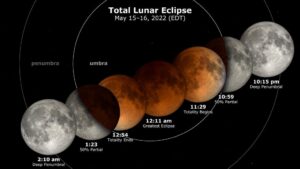
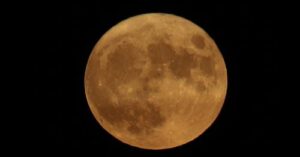
This weekend you can catch a rare “Super Blood Moon” or “Super Flower Blood Moon” total lunar eclipse across all the US. More info below, but here are the best viewing times. It’ll happen right around midnight on Sunday, EDT.
Specific Times of Total Lunar Eclipse (EDT)
Partial eclipse begins at 10:27 PM May 15
Totality begins at 11:29 PMEDT
Totality ends at 12:54 a.m. EDT
Partial eclipse ends at 1:55 AMEDT (May 16)
‘Super Flower Blood Moon’ Lunar Eclipse is Coming Sunday Night. Here’s What You Need to Know.
During the eclipse, the moon will receive only sunlight bent through the Earth’s atmosphere, and will change color over the minutes, from gray to pink to orange to red.
The Earth’s shadow covers the moon, which often has a red color, hence the blood moon nickname. Although it’s completely in the shadow of Earth, a bit of reddish sunlight still reaches the moon.
The eclipse will begin when the Earth’s shadow appears on the moon at 10:27 p.m. EDT Sunday evening. Over the course of an hour, the shadow will creep across the moon, plunging the lunar surface into darkness.
Totality, or when the moon is entirely in the Earth’s shadow, will occur from 11:29 p.m. May 15 to 12:53 a.m. May 16.
You don’t need special glasses or gizmos to view the spectacle, unlike a solar eclipse, so feel free to stare directly at the moon. Binoculars or a telescope will improve the view.
The eclipse will be visible in total phase from portions of the Americas, Antarctica, Europe, Africa and the east Pacific, according to Space.com,
This will be the first of two lunar eclipses in 2022, Space.com said. The next one will occur Nov. 8.
What is a supermoon?
A supermoon means the moon looks a bit bigger than usual since it’s a bit closer to the Earth.
“Because the orbit of the moon is not a perfect circle, the moon is sometimes closer to the Earth than at other times during its orbit,” according to NASA.
On average, supermoons appear about 7% bigger and about 15% brighter than a typical full moon.
It’s also the ‘flower’ moon
Sunday’s sky show is also the “flower” moon, a name given to May’s full moon because “flowers spring forth across North America in abundance this month,” the Old Farmer’s Almanac said.
The full moon names used by the almanac come from a number of places, including Native American, Colonial American and European sources. Traditionally, each full moon name was applied to the entire lunar month in which it occurred, not solely to the full moon.
Other names for May’s full moon include the corn planting moon and the milk moon, NASA said.
I’m looking forward to participating in the Tennessee Williams Festival again this weekend at the Hotel Monteleone in New Orleans.
Sunday morning, March 26, I’ll be speaking with writers Mahyar Amouzegar, Tom Cooper, Louis Edwards, and Roy Hoffman about “Character and Setting.”
It’s an all-male panel, so you can bet there’ll be lots of drinking and cussing. Come join us if you’re in town. More info below and in link. Get your Tennessee on.
OH, THE PLACES YOU’LL GO: CONNECTING CHARACTER AND SETTING
Sunday, March 27, 11:30 AM—12:45 PM—Literary Discussion
Placing a character in a particular setting opens up so many narrative choices—how the characters engage with that landscape, how to authentically create life in a specific place. Sometimes the setting itself becomes a character. These writers have set their work in places as diverse as Florida and Syria during wartime, and they will discuss powerful relationships between people and places. Panelists include Tom Cooper, Louis Edwards, Roy Hoffman, and Mahyar Amouzegar. Moderator: George Bishop, Jr.
Hotel Monteleone, Queen Anne Ballroom, $10 or Literary Discussion Pass or VIP Pass
One of the brightest heralds of spring makes its appearance this week.
The March full moon, known as the worm moon, will be at its peak at 3:18 a.m. ET on Friday, March 18, according to NASA. It will appear full through Saturday morning.
(See more below for, er, how it got its name.)
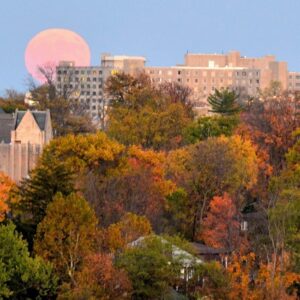
This moon will appear larger to viewers because of the “moon illusion,” according to the Old Farmer’s Almanac. This occurs when the moon is near the horizon and our eyes compare the moon’s size to trees, buildings or other earthly objects. By comparing these reference points to the moon, our brain tricks us into thinking the moon is bigger.
Southern Native American tribes named the worm moon after the earthworm casts — essentially feces — that emerged as the ground thawed at winter’s end, according to NASA.
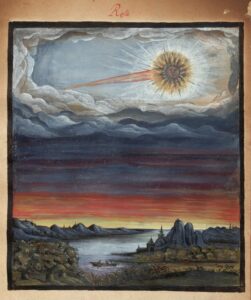
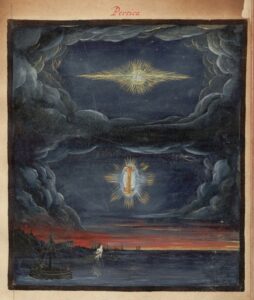
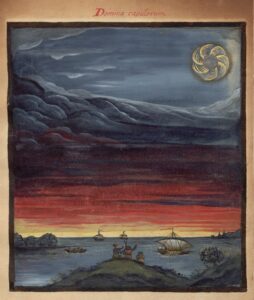
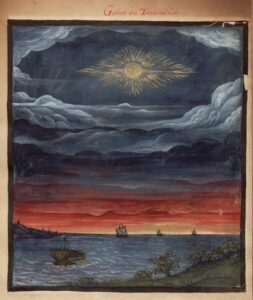
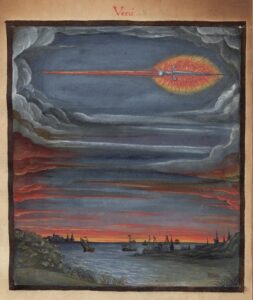
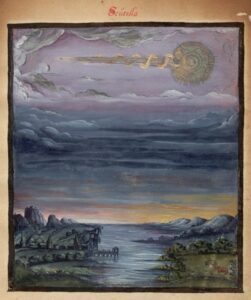
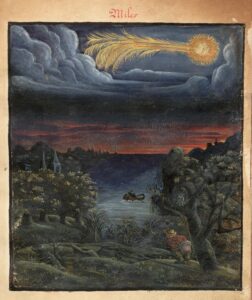
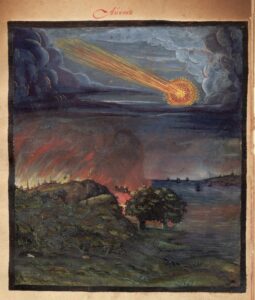
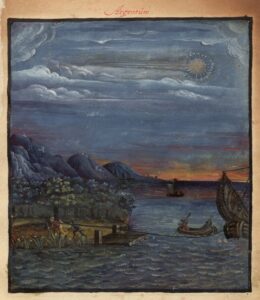
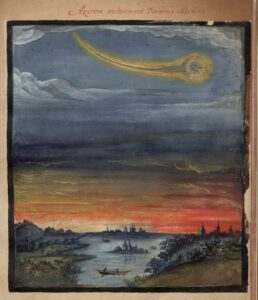
“This stunning set of images come from a 16th-century treatise on comets, created anonymously in Flanders (now northern France) and now held at the Universitätsbibliothek Kassel. Commonly known as The Comet Book (or Kometenbuch in German), its full title translates as “Comets and their General and Particular Meanings, According to Ptolomeé, Albumasar, Haly, Aliquind and other Astrologers.””
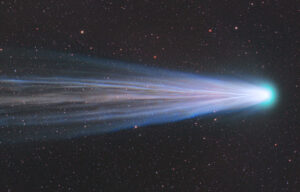
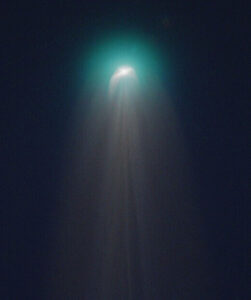
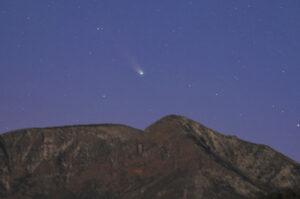
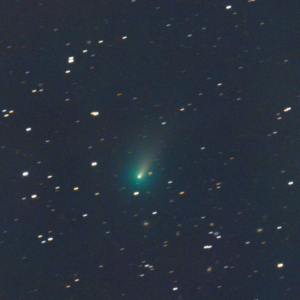
There’ve been some remarkable photos of Comet Leonard as it approaches the sun. Here are a few recent ones, taken from Sky and Telescope.
Braided flows of gas and dust stream from the head of Comet Leonard in a photo taken with an 8-inch telescope and QHY600 camera on December 24, 2021. Michael Jäger and Lukas Demetz.
Like water from a rotary lawn sprinkler, dust jets blast from the comet’s false nucleus in this carefully processed image from December 23, 2021. Michael Jäger, Lukas Demetz and Qi Yang
Comet Leonard shows off a pretty tail several degrees long on December 19, 2021, from Payson, Arizona. The comet’s altitude at the time was about 10°. Chris Schur
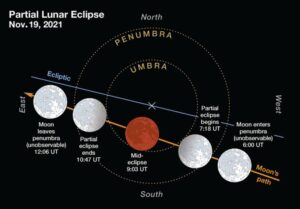
Heads up for this spectacular lunar eclipse in the pre-dawn hours of Nov 19, 2021. Lasting 6 hours, it’ll be the longest lunar eclipse in almost 600 years. Expect excellent visibility all across North and South America, much of Asia, and parts of Europe and west Africa. During the period of maximum eclipse, the Moon may appear a deep red color.
In North America, the period of maximum eclipse will be right around 4:00 a.m. EST, with almost 2 hours of partial eclipse before and after that.
Beaver Moon lunar eclipse 2021: When, where and how to see it on Nov. 19
By Elizabeth Howell
This will be the longest partial lunar eclipse in nearly 600 years.
On Nov. 19, a partial lunar eclipse will reward patient sky observers with a view of a subtly changing moon and is a must-see event as it’s the last lunar eclipse of the year. The moon may even take on a reddish hue.
Lunar eclipses occur when the moon passes into the Earth’s shadow. In this case, the partial eclipse phase will last 3 hours, 28 minutes and 24 seconds, and the full eclipse for 6 hours and 1 minute, making it the longest partial eclipse in 580 years, according to Indiana’s Holcomb Observatory.
At maximum eclipse, the moon’s face will be 97% covered by the deepest part of the Earth’s shadow and will probably turn a deep red, the observatory said. November’s full moon is traditional known as the Beaver Moon, as beavers are preparing for winter, hence this month’s event’s Beaver Moon eclipse moniker.
Visibility will be excellent across the Americas, much of Asia and parts of Europe and west Africa, and with the long event time you’ll have maximum opportunity to dodge clouds or crowded schedules to see the event unfold.
“Partial lunar eclipses might not be quite as spectacular as total lunar eclipses – where the moon is completely covered in Earth’s shadow – but they occur more frequently,” NASA said in a description of the eclipse. “And that just means more opportunities to witness little changes in our solar system that sometimes occur right before our eyes.”
Lunar eclipses are long events. This one will last about six hours and will peak at 4:02 a.m. EST (0902 GMT). The event will be visible from North and South America, Australia, and parts of Europe and Asia.
The eclipse will take place in four main phases, according to NASA. At 1:02 a.m. EST (0602 GMT) the moon will enter the penumbra, or the lighter part of the moon’s shadow. This phase is usually hard to spot without special equipment because the darkening is so slight.
The moon will then arrive at the umbra, or the darker part of the shadow, at 2:18 a.m. EST (0718 GMT). Here you will get to enjoy about 3.5 hours of the moon passing through the deep shadow until it exits the umbra at 5:47 a.m. (1047 GMT). The eclipse will end at 6:03 a.m. EST (1203 GMT).
Assuming you can see the entire eclipse, the moon will have different appearances at different stages of the event. While it is in the penumbra or lighter part of the Earth’s shadow, it may be difficult for you to see anything at all, especially if you live in a light-polluted region. But as the moon moves closer to the umbra or deep shadow, it will begin to darken, turning a bit greyer than usual.
As the moon approaches the deepest part of the eclipse, the moon will likely turn a dark red or a brown region as it will be 97% eclipsed at the peak. The moon won’t be covered all the way, though, as at the point of greatest eclipse there will still be a region near the bottom of the moon (or top of the moon, if you are viewing through many kinds of telescopes) that is in full sunlight.
Depending on where you are located, you may not be able to see all of the eclipse. The entire sequence is visible for most of North and Central America, along with the far east of Asia, although extreme eastern regions of the Americas may only be able to view the eclipse before the moon exits the umbral phase.
South America will see most of the eclipse before moonset. Europe and western Africa will see some of the beginning of the eclipse, and central Asia along with the southern Pacific and Australia will see some of the eclipse around moonrise. You can find more details about your region at the NASA website.
Look for Comet Leonard–sighted just last year–to make a bright showing this New Year’s.
Comet Leonard, Oct 29, 2021
From EarthSky News:
Exciting news! A much-anticipated comet is brightening and still might become 2021’s brightest comet. Astronomer Greg Leonard discovered the comet that now bears his name – C/2021 A1 (Leonard) – last January 3. Astronomers reported then that discovery images showed a tail for the comet, suggesting we might see a nice tail as Comet Leonard draws closer to the Earth and sun. The comet is now between the orbits of Mars and Earth, heading inward. Comets are typically brightest around the time they’re closest to the sun. And Comet Leonard will reach perihelion, its closest point to the sun, around January 3, 2022. That’s after its closest point to Earth on December 12.
You don’t have to be a hunter to enjoy the Hunter’s Moon tonight, Oct. 20. More below from EarthSky. Happy viewing and/or hunting.
“The Hunter’s Moon is the full moon after the Harvest Moon. It usually falls in October, but, if not, it falls in early November. [ . . .] It’s a characteristic of the Hunter’s Moon to rise around the time of sunset for several evenings in a row, as if this month has more than one full moon.”
Hunter’s Moon
Hunter’s Moon October 20, 2021
The Hunter’s Moon is the full moon after the Harvest Moon. It usually falls in October, but, if not, it falls in early November. October 2021’s full moon – the Northern Hemisphere’s Hunter’s Moon – will be 100% lit on October 20 at 14:56 UTC; translate UTC to your time. On October 21, and even on October 22, you might glimpse a full round moon ascending in the east in early evening. It’s a characteristic of the Hunter’s Moon to rise around the time of sunset for several evenings in a row, as if this month has more than one full moon.
Eastern Australia and New Zealand will see the full moon on October 21. It’s not a Hunter’s Moon for the Southern Hemisphere because it’s spring in that hemisphere now. So the full moon has different characteristics.
Every full moon has a slew of nicknames, and most are tied to months of the year. But some moon names, such as the Harvest and Hunter’s Moons, are tied to seasons. The Harvest Moon is the full moon closest to the September equinox, or autumnal equinox for the Northern Hemisphere. The equinox is typically September 22 or 23. So most Harvest Moons come in September. But, every three years, the Harvest Moon falls in early October and the Hunter’s Moon in November.
In North America, the Harvest Moon was a time when the bright moon meant farmers could stay out later, working in their fields, gathering in the crops before the first freeze. After the harvest, farmers would turn to hunting deer and other animals to bolster their food stores before winter. The light of the full moon would let them hunt into the evening hours. So today we have a Hunter’s Moon.
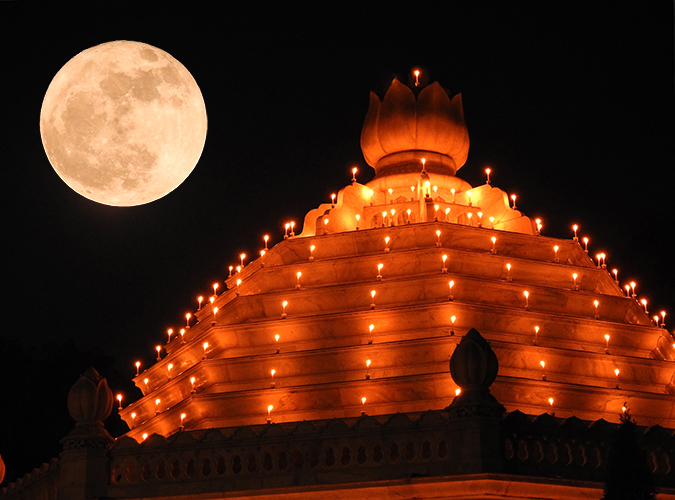
The West’s Hunter’s Moon is sometimes celebrated as Kartik Purnima in India. In 2021, the dates vary a bit. The festival will come around the November full moon (night of November 18-19 in India). Swami Krishnananda in Ranchi, India, captured this photo during Kartik in 2017. Thank you, Swami Krishnananda!
What makes this moon special?
Nature is particularly cooperative around the time of the autumn equinox to make the fall full moonrises unique. On average, the moon rises about 50 minutes later each day. But when a full moon happens close to the autumnal equinox – either a Harvest or a Hunter’s Moon – the moon (at mid-temperate latitudes) rises only about 30 to 35 minutes later daily for several days before and after the full moon. The reason is that the ecliptic – or the moon’s orbital path – makes a narrow angle with the evening horizon around the time of the autumn equinox.
The result is that there’s a shorter-than-usual lag time between successive moonrises around the full Hunter’s Moon.
Early evening moonrises make every Hunter’s Moon special. Every full moon rises around sunset. After the full Hunter’s Moon, you’ll see the moon ascending in the east relatively soon after sunset for a few days in a row at northerly latitudes.
If you’re in the Northern Hemisphere, look for the moon to be bright and full-looking for several nights from around October 19 to the 22. Around all of these nights, you’ll see a bright round moon ascending in the east in the evening hours.
It’s not too late to catch 2021’s Harvest Moon. From NPR: “For three days, moonrise will come shortly after sunset, but the harvest moon will reach its peak illumination at 7:54 p.m. ET Monday. Historically this lunar event provided farmers a little extra light to harvest their crops.”
For those in the Northern Hemisphere, summer will come to an end next Wednesday. Slowly but surely since the middle of June, days have been getting shorter. With the arrival of the autumn equinox comes cooler weather and a change of color amongst the trees. And Monday, two days before the official start of fall, the harvest moon.
For three days, moonrise will come shortly after sunset, but the harvest moon will reach its peak illumination at 7:54 p.m. ET Monday. Historically this lunar event provided farmers a little extra light to harvest their crops. However, unlike the equinoxes, which take place at the same time each year, the harvest moon is the full moon closest to the autumnal equinox. Which means it can fall in September or October, according to The Old Farmer’s Almanac.
But that’s not all that changes with the last full moon of the summer. You may recall glancing up at the night sky and noticed the moon varies in size from time to time. That’s because the its orbit around the Earth isn’t a perfect circle, NASA explains.
Sometimes the harvest moon appears to be enormous, such as in 2015, when it was the year’s closest and biggest super moon. The moon appears so much larger during super moon events because it’s closer to Earth, known as the perigee. At its closest point the moon is about 226,000 miles from Earth. But sometimes the harvest moon occurs when the moon is furthest from Earth in orbit, the apogee, at 253,000 miles away.
If spectators catch the moon rising at just the right time, it will appear orange in color. But this theatrical touch isn’t specific to the harvest moon. The moon varies in color depending on a handful of factors, including where the viewer is standing. When Earth’s satellite is closest to the horizon it takes on a red or yellow color, NASA says. But as it continues to rise it will gradually take on its traditional pale, white color.
East Asian culture celebrates the August Moon Festival, which doesn’t always coincide with the rising of the harvest moon itself. According to the Boston Public Library, the festival can be traced back to 771 B.C. and was celebrated by harvesting rice and wheat on the night of the full moon. Similar to Thanksgiving in the United States, the August moon is celebrated by the gathering of friends and families, but instead of turkey, people eat mooncakes, a sweet and savory dessert.